Los Angeles Indymedia : Activist News
| About Us | Contact Us | Calendar | Publish | RSS |
|---|
|
Features • latest news • best of news • syndication • commentary Feature Categories IMC Network:
Original Citieswww.indymedia.org africa: ambazonia canarias estrecho / madiaq kenya nigeria south africa canada: hamilton london, ontario maritimes montreal ontario ottawa quebec thunder bay vancouver victoria windsor winnipeg east asia: burma jakarta japan korea manila qc europe: abruzzo alacant andorra antwerpen armenia athens austria barcelona belarus belgium belgrade bristol brussels bulgaria calabria croatia cyprus emilia-romagna estrecho / madiaq euskal herria galiza germany grenoble hungary ireland istanbul italy la plana liege liguria lille linksunten lombardia london madrid malta marseille nantes napoli netherlands nice northern england norway oost-vlaanderen paris/Île-de-france patras piemonte poland portugal roma romania russia saint-petersburg scotland sverige switzerland thessaloniki torun toscana toulouse ukraine united kingdom valencia latin america: argentina bolivia chiapas chile chile sur cmi brasil colombia ecuador mexico peru puerto rico qollasuyu rosario santiago tijuana uruguay valparaiso venezuela venezuela oceania: adelaide aotearoa brisbane burma darwin jakarta manila melbourne perth qc sydney south asia: india mumbai united states: arizona arkansas asheville atlanta austin baltimore big muddy binghamton boston buffalo charlottesville chicago cleveland colorado columbus dc hawaii houston hudson mohawk kansas city la madison maine miami michigan milwaukee minneapolis/st. paul new hampshire new jersey new mexico new orleans north carolina north texas nyc oklahoma philadelphia pittsburgh portland richmond rochester rogue valley saint louis san diego san francisco san francisco bay area santa barbara santa cruz, ca sarasota seattle tampa bay tennessee urbana-champaign vermont western mass worcester west asia: armenia beirut israel palestine process: fbi/legal updates mailing lists process & imc docs tech volunteer projects: print radio satellite tv video regions: oceania united states topics: biotechSurviving Citieswww.indymedia.org africa: canada: quebec east asia: japan europe: athens barcelona belgium bristol brussels cyprus germany grenoble ireland istanbul lille linksunten nantes netherlands norway portugal united kingdom latin america: argentina cmi brasil rosario oceania: aotearoa united states: austin big muddy binghamton boston chicago columbus la michigan nyc portland rochester saint louis san diego san francisco bay area santa cruz, ca tennessee urbana-champaign worcester west asia: palestine process: fbi/legal updates process & imc docs projects: radio satellite tv |
json version - view hidden posts
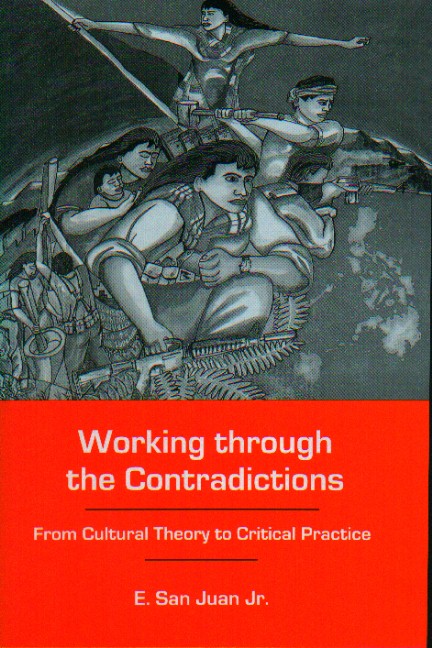
E. SAN JUAN's NEW BOOK ON CLASS STRUGGLE IN THE GLOBAL CULTURAL FRONTby Jeffrey Cabusao Tuesday, Oct. 11, 2005 at 9:38 PMjcabusao@umich.edu E. SAN JUAN's new book of essays, Working Through the Contradictions: From Cultural Theory to Critical Practice (Bucknell University Press), engages with, among other things, the problem of cultural revolution in the Philippines and the plight of the Filipino Overseas Contract Workers, the 10 million Filipino diaspora, around the world. Without revolutionary theory, as Lenin said, there cannot be any revolutionary praxis. This is a small contribution to the formation of that theory in practice.
E. SAN JUAN’S new book: WORKING THROUGH THE CONTRADICTIONS (Lewisburg, Pa: Bucknell University Press) Cultural Theory and Critical Practice in the age of Globalization By JEFFREY CABUSAO Dept of English University of Michigan Ann Arbor, Michigan, USA At the beginning of his witty and thought-provoking After Theory, Terry Eagleton inventories the ways in which the “cultural turn” in theory has unfolded and centered on localized, consuming bodies: “Structuralism, Marxism, post-structuralism and the like are no longer the sexy topics they were. What is sexy instead is sex. On the wilder shores of academia, an interest in French philosophy has given way to a fascination with French kissing. In some cultural circles, the politics of masturbation exert far more fascination than the politics of the Middle East. Socialism has lost out to sado-masochism. Among students of culture, the body is an immensely fashionable topic, but it is usually the erotic body, not the famished one. There is a keen interest in coupling bodies, but not in labouring ones. Quietly spoken middle-class students huddle diligently in libraries, at work on sensationalist subject like vampirism and eye-gouging, cyborgs and porno movies” (2-3). According to Eagleton, this particular development in theory has enabled teachers and students of Cultural Studies to engage the pleasures (the politics of consumption) of everyday life, “only at the risk of losing their ability to subject it to critique.” Given the current state of theory, Eagleton asks, “[w]hat kind of fresh thinking does this new era demand?” In response to the nihilism of our current post-9-11 period-- the age of corporate capitalism and intensified U.S. imperial hegemony-- prolific Filipino cultural theorist E. San Juan, Jr. offers Working through the Contradictions: From Cultural Theory to Critical Practice, a collection of classic and new essays. San Juan provides insightful, innovative, and fresh thinking that opens critical spaces for us to imagine new ways of resituating desire beyond the boundaries of individual consumption and toward the realm of collective social transformation and spiritual renewal. What marks San Juan’s project as “different” in our contemporary intellectual landscape of “end-isms” (end of theory, end of history, end of ideology, etc.) is its commitment to a liberatory vision for genuine social change and freedom. In his introduction, San Juan explains: “My project here is to affirm [that]… alternatives exit… We face hard choices every day as we shoulder the nightmarish burden of history. Although there are no guarantees one way or the other, it bears repeating that the world is open for us to re-invent or construct anew, and the future is here for us to shape if we dare imagine it, in accord with our collective desire for equality, justice, happiness, and liberation.” Working through the Contradictions is divided into three parts: Embarkations, Trajectories, and Rendezvous. In part one, San Juan embarks on the project of dialectically seizing the contradictions of contemporary globalization in relation to the current state of Cultural Studies and American Studies. Examining Marx, Engels (his unique contribution to theorizing aesthetics and cultural politics), Lukacs, Gramsci, and Raymond Williams, San Juan generates a genealogy of historical materialist thought, which provides the foundation for an insurgent model of Cultural Studies. In the final chapter of this section, San Juan meditates on “Third World” articulations of surrealism (Cesaire, Vallejo, etc.), an aesthetics of subversion. In part two, San Juan turns to Frantz Fanon as a cultural critic, whose writings enable us to confront racial injustice on a global scale (or what African American scholar-activist Manning Marable calls global apartheid) as well as to engage the on-going necessity of national liberation and self-determination for those in the Global South and in the internal colonies of the United States. Pushing against orthodox postcolonialism, San Juan’s re-assessment of Fanon brings the U.S. Empire to the fore in a way that sheds light on the repressed history of U.S.-Philippines relations-- the latter was brutally colonized by the former at the turn of the 20th century (Spanish American War, 1898; Filipino American War, 1899-1914). Part three reveals various ways in which subalterns have always spoken. Currently, 10 million Filipino migrant workers (female and male laboring bodies) are dispersed around the globe. In this final section of the book, San Juan concretizes his insurgent model of Cultural Studies by examining the counterhegemonic narratives of Filipino migrant workers; assessing the works of Toni Morrison, Kiana Davenport, David Henry Hwang; considering philosopher Benedict de Spinoza’s “principle of the inalienability of human rights [which] can renew the impulse for reaffirming the ideal of radical, popular democracy.” San Juan uses Spinoza to help us understand new forms of racialization in our post 9-11 era, especially with regard to multiple forms of racist violence (racial profiling, deportations, violations of civil liberties) directed at Asian American communities. In the Afterword, San Juan explores how the work of progressive African American writer and journalist Mumia Abu-Jamal (imprisoned on death row since 1982) embodies Spinoza’s concept of freedom: “Genuine freedom always involves a collective process of becoming-free.” In this stunning collection of essays, E. San Juan, Jr. -- one of our most important Filipino/Asian American critical thinkers and scholar-activists-- addresses an astoundingly wide range of issues and debates within Cultural Studies in our age of globalization. Working through the Contradictions (with a Foreword by literary critic Barbara Harlow) is useful for all teachers and students in Cultural Studies, U.S. Ethnic and Racial Studies, American Studies, Comparative Literary Studies, Critical Theory, Globalization Studies, Women’s Studies, and U.S. Empire Studies. We may find answers to Eagleton’s question about the future of theory in Working through the Contradictions. |